


Team building that gets your team to genuinely collaborate
Professional actors, tension and real-time interaction put teams in situations where they truly have to work together. For 5–500 people, in 30+ cities or at your own venue.








Why this works differently from standard formats
A lot of team building gets stuck on loose exercises or an afternoon that is mostly well-intentioned. NEVERREST works differently: through actors, tension and real-time interaction, situations emerge where people don’t just take part but genuinely have to function as a team. Information has to be shared, choices have to be made, and precisely because of that, collaboration, trust and communication are not explained but made visible.
Honest about what this is: not an assessment and not a classic training programme, but a shared experience in which collaboration is naturally required. Precisely because it doesn’t feel like school, people respond more naturally, and you often see more than in an explicit training setting.
Twenty-five years, 200,000 people, one method that holds
Since 2000 we have directed this for teams of every shape and size. The numbers are not the point — but they tell you the method holds up under real pressure.
Directing teams since day one
Twenty-five years of live-directed experiences, refined event after event with professional actors at the centre of every scene.
Participants and counting
More than 200,000 people have been pulled into a NEVERREST story, from four-person departments to companies of five hundred.
Written testimonials
Over 1,500 teams have put their reaction in writing, behind a 5 out of 5 Google score. Real reviews, real reactions.
Any group size
From an intimate team of five to a floor of five hundred, split into subteams of four to six. Nobody watches from the sidelines.
The essentials, at a glance
Everything a decision-maker usually asks in the first email, gathered in one place.
- Group size — 5 to 500 people, in subteams of 4 to 6.
- Duration — typically 2.5 to 4.5 hours, easily shortened or extended in consultation.
- Setting — indoor, outdoor or hybrid, at your own venue or out in the city.
- Coverage — The Game plays outdoors in 30+ cities across the Netherlands and Belgium; Social Chaos travels to any venue.
- Built for — corporate teams, departments, leadership groups and international, mixed-language teams.
- Included — professional actors, live game facilitation and all materials.
How a NEVERREST day comes together
You don’t run anything. You host — we direct.
The intake
A short conversation about your goal, group size, location, timing and the energy you’re after. Fifteen minutes is usually enough to shape the day.
The design
We build the flow: storyline, team set-up and every practical detail, tuned to your surroundings and prepared well in advance.
Showtime
Your team arrives and the experience unfolds around them, guided by actors and a facilitator, closing on a finale that sticks.
From a team of five to a floor of five hundred
NEVERREST scales without losing its grip. We adjust pacing, actor distribution and narrative complexity so the experience stays crisp at any size.
5 to 25 people — deeper interaction and sharper teamwork dynamics, where every individual response is visible.
25 to 120 people — balanced competition and collaboration across teams, with actors moving between the groups.
120 to 500 people — clear structure, multiple zones and a rhythm engineered so nobody stands waiting.
Wherever it runs — an office, a hotel, a conference venue or straight through a city centre — the storyline is adapted to the surroundings and prepared beforehand. Social Chaos brings screens, projectors and complete infrastructure to the location of your choice; The Game takes to the streets of 30+ cities across the Netherlands and Belgium. International and mixed-language teams play every week, in English, Dutch or a blend of both.
When is team building a logical choice?
When collaboration is more effortful than it needs to be
The team performs fine on content, but alignment costs too much energy: people work past each other and information gets stuck. Team building makes collaboration tangible again.
When trust needs to grow stronger
Trust doesn’t grow by talking about it, but by ending up in situations together where you have to rely on one another. NEVERREST makes that tangible.
When a team is stuck in familiar patterns
Roles are fixed, reactions are predictable, new energy fails to appear. The experience pulls people out of the routine and forces them to look and respond differently.
After growth, changes or reorganisation
A team has to re-form. Shared reference points help new colleagues become part of it faster, an acceleration of how people click.
What you’ll see along the way
Not in theory, but in the middle of a situation where people have to react, switch and rely on each other.
Who keeps an overview
In every group there are people who stay calm as the tension rises, you see not just who is strong on content, but who helps the team when things get intense.
Who connects and aligns
Some colleagues make sure information keeps flowing rather than getting stuck. That connecting behaviour becomes strikingly clear along the way.
Who takes the initiative
Real tension shows who naturally steps forward and who prefers to follow, not to judge, but to understand team behaviour more sharply.
How the team reacts under pressure
As pace and uncertainty increase, you see how a team really collaborates: who communicates, who stays calm, where misunderstandings arise.
Managers and HR recognise much of what plays out in day-to-day collaboration too, but is normally less visible. Want to take it further deliberately? Then we discuss beforehand what you want to watch for, as talking points afterwards, not as an assessment.
Which format suits your team goal?
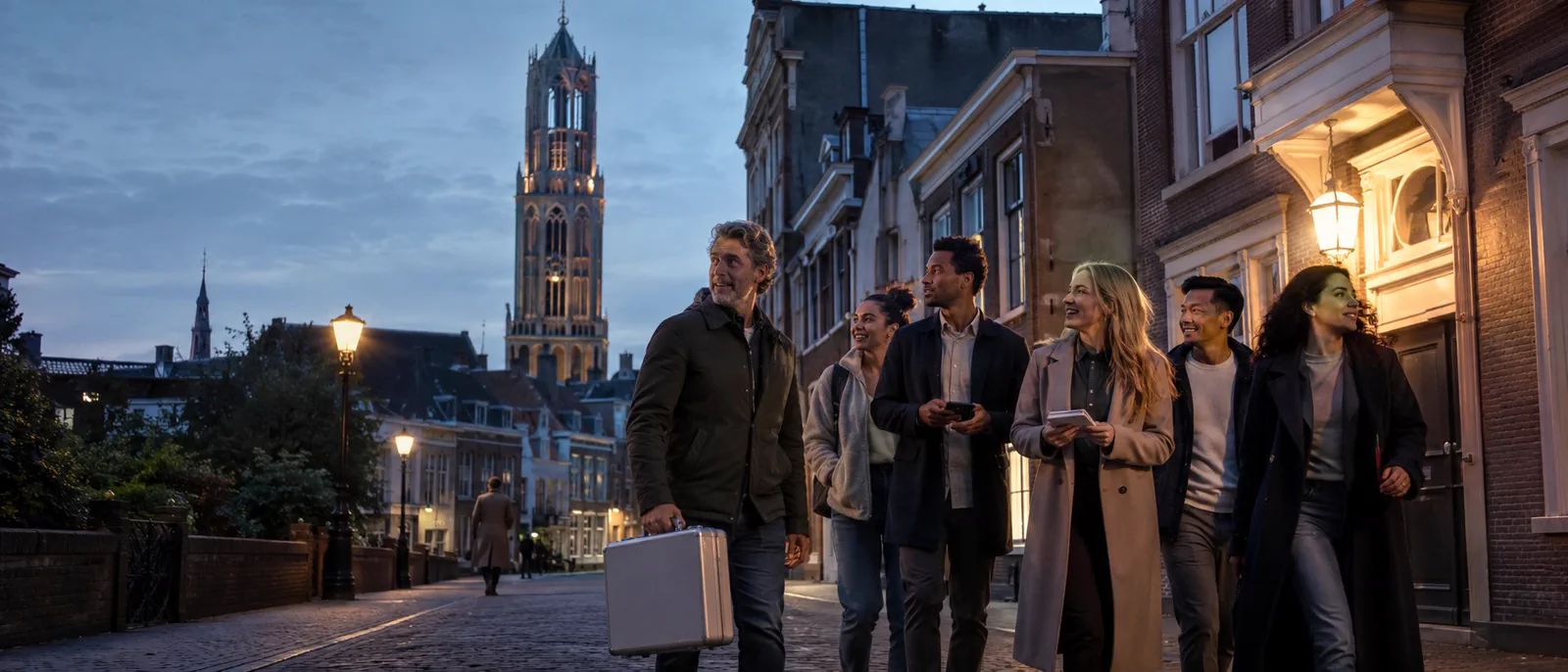

Teams are slowly drawn into a story where trust, alignment and mutual sharpness matter. Strong for teams that need to grow closer together.
Discover The Game →

More direct and intense: switching, sharing information, reacting quickly and keeping a grip as a team while the pace rises. Strong for collaboration, role division and shared focus.
Discover Social Chaos →Choose by team goal: trust, connection and alignment → The Game. Pace, focus and collaboration under pressure → Social Chaos.
Frequently asked questions about team building
How long does a team building programme take?
Is it physically demanding?
Can it take place at our office or in a hotel?
Does it work for international teams?
What works best for 100+ participants?
What does a NEVERREST event cost?
It depends on the size of your group. The Game costs € 920 for a team of up to 10 people, without acts. Social Chaos starts at € 1,895 for up to 20 people, actors included. At 30 participants that is € 1,940 and € 2,390.
| Group | The Game without acts |
Social Chaos actors included |
|---|---|---|
| up to 10 | € 920 | € 1,895 |
| 20 people | € 1,540 | € 1,895 |
| 30 people | € 1,940 | € 2,390 |
| 50 people | € 2,950 | € 3,040 |
| 200 people | € 9,060 | € 10,910 |
Total prices excluding VAT, 2026 rates. For The Game, acts are added on top of the total and scale with group size; for Social Chaos the film is optional. The full price list is in the brochure.
Team building, explained
The questions people type into a search bar before they ever pick up the phone.
What is team building?
What is a team building experience?
Why is team building important?
What is a good example of a team building experience?
Is team building one word or two?
Explore further
Mainly after fun and atmosphere?
Then a team outing probably fits better: the same concepts and quality, but with the emphasis on experience rather than collaboration under pressure.
Team building in Amsterdam
Amsterdam’s canals and old centre are a ready-made film set. In The Game, professional actors turn the historic inner city into a cinematic city game: your team plays outdoors along a 2-4 km walking route, hosted live by our game leaders. Prefer to stay inside? Social Chaos brings an escape experience with actors to your own Amsterdam venue — we bring all the technology, and in rough weather the programme runs fully indoors. Suitable for 5 to 500 people, in English, Dutch or mixed. From EUR 920 for up to 10 people, EUR 1,940 at 30 (excl. VAT).